Rafael runs an AI and IoT software company (Poland, plus a small Ukrainian entity; Ukrainian wife and daughter). The idea: bring intelligent automation to drones, prototype something Ukrainian front-line units actually need, and, if it proves useful, move into production. Two front-line contacts have been interviewed. This hub holds the briefings, the merged intelligence, and a hard-nosed market reality check.
Start with The Catch if you read only one thing, it answers the uncomfortable question of why this all feels too easy. Then use the combined intel and per-call briefings to prep the next conversation.
Newest first. The date on each card is when it was produced. Full chronology in the timeline below.
The buildable version of Rafael's air-gapped LLM-plus-RAG pitch: which open-weight model is legal for EW R&D (avoid Meta Llama, pick Qwen3/Apache-2.0), tiered hardware against the $5-20k hedge, the full reuse-this-repo software stack, and the real answer to the "hard to enforce" data-feeding crux, plus a cheap PoC to run now.
The morning-after read on the Saturday Krakow meeting with the anti-drone partner ("Yuri"): what we now know, four ways we could cooperate, where it could land, and a candid odds call. The headline correction: the "Kyiv factory" is really a producer network, and his real name is still unconfirmed.
The receipt for the mobile pass. Every briefing page loaded in a headless browser at 390x844 (phone) and 1440x900 (desktop): no page overflows horizontally on mobile (scrollWidth equals clientWidth equals 390 everywhere) and desktop is unchanged with zero console errors. Includes a per-page table, 30 screenshots, and the Yuri brief's new models-by-unit + expanded questions.
The receipt for a project-wide quality pass. Every wiki entity, concept, summary, status and navigation page plus all briefing HTML audited against ground truth: missing facts filled, what-to-do/what-to-ask sections added to every entity and status page, Uryi vs Vyriy fixed, all briefing files relinked, index count corrected. Verdict: complete.
The "something solid" for the Yuri meeting: real demand (brigade + 419th battalion), a prioritized drone requirements table with anti-drone front-and-center (his specialty), the quality bar, phased volumes, and a focused question list for the meeting.
New from four WhatsApp threads (text + 6 voice notes): Dimas's hard specs (10-30km, 1.5-4.5kg) + anti-drone picks, Serhii's unit (419th UAV Battalion) and his steer that fiber is fading while retranslator/recon-wing/deep-strike rise, and Illia's fiber-import opening ($34/km, none available) with Serhii's demand counter-signal.
Internal: full specs + needs for Dimas and Serhii (419th), the strategy to run with each (paid beachhead vs donation-first + intel), and how to use Ilia as the build partner. Includes a side-by-side comparison.
Triangulated three ways: a typical active brigade has ~UAH 20-33M/month (~$500-800k) for drones via the official channel alone, ~$0.5-1.3M all-in. Dimas's "brigade money" is real and large. Budget is not the gate, the marketplace + codification (Ilia) is. A 15-unit test is pocket change for him.
Top optical-fiber producers in Brazil (Prysmian, Furukawa/Lightera) and what good-quality long-range drone canisters cost at 20/30/40km, G.657.A2, Jinxingtong-class. The key finding: Brazil makes the glass but nobody here makes the finished payout spool, and the factory-to-warzone price spread runs from ~$55 to ~$2,500.
The 13 exact models Serhii runs (Vyriy, Gromylo, Beshket, General Cherry, F10, Rarog, Shrike, Kolibri + Baba Yaga night bombers), researched into one spec sheet with photos, payloads, ranges and price ranges. Ends with your MVP requirements envelope (10-13in fiber, 3-4kg, 15-20km reliable) and the answer to give Serhii on VTOL.
Everything from four conversations and seven research threads, synthesized: what you have, what the Ilia call changed, the one strategy that fits (be the quality/trust/intelligence layer, not a drone maker), a staged plan with decision gates and kill criteria, risks, and this week's actions. Updated odds: ~30/100.
The prioritized question sheet for the Illia Cheherst call: a top-five, a plain-English procurement glossary (DPA, codification, Brave1, DOT-Chain, e-points, localization), and themed blocks to leave knowing what the factory really is and where your AI/IoT is the irreplaceable piece.
The full ~1-hour Google Meet with Illia Cheherst (Ukrainian manufacturer, SkyPulse electronics; held 2026-05-26). The insider market education that reframed the whole opportunity: the problem is producers cutting corners, not the parts, and cash flow is the real killer.
The WhatsApp intro thread that set up the Illia call: Sayed's introduction, the Google Meet scheduling (Illia available 16:00-20:00 Kyiv, call set 18:45), and first context on his electronics business.
Why are units talking to a small foreign developer when thousands of suppliers exist? The honest, sourced answer: Ukraine is money-constrained not supply-constrained, a unit conversation costs them nothing, and the "sell finished drones to the ministry" model is the one Ukraine is legislating against. Includes a verdict with recommendations and counter-arguments.
Dimas and Serhii side by side, every claim tagged by who said it. Where two different units agree (high confidence), where they diverge, a full comparison table, and the prototype direction it all points to.
Dimas's second call: his brigade commander signed off, he offered an in-person meeting in Dnipro, and the local-partner thread (Ilia) opened. Also: the "polygraph" you heard was "Pavlohrad", a city, no vetting test.
Full transcript of the 4.5-minute logistics call (~2026-05-25): commander approval, the Dnipro meeting offer, and the Kiev-factory partner.
The first call: fiber-optic cable and battery quality pain, ~20 percent hit rate, hard line on AI targeting, plus your five draft follow-up questions scored against what he already answered.
Decoding his "75,000 to one" price (it was hryvnia, ~$1,800, not $75k USD, a ~40x correction) and using it to guess his fleet: fiber strike FPVs, DJI-video radio FPVs, Starlink-Mini drones, and a heavy bomber tier. Sets your real cost ceiling.
Full verbatim transcript of the 12-minute Dimas voice note (2026-05-23), transcribed from the mislabeled audio file.
Full speaker-labeled transcript of the Serhii Smirnov interview (video call, 2026-05-22 13:00 CET): signal loss, auto-aim that failed, the e-points system, procurement, and certification.
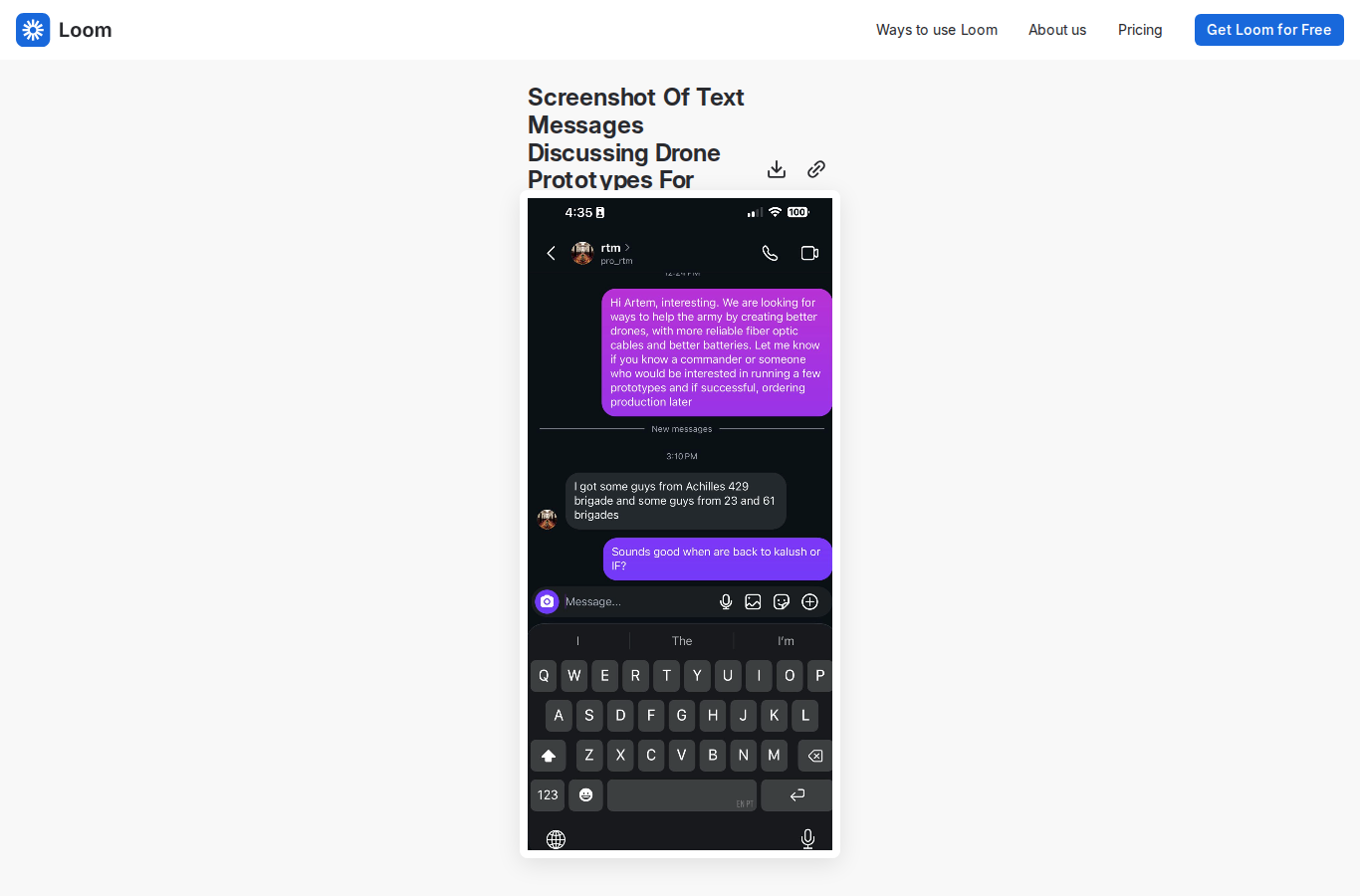
A screenshot of an "Artem" Loom message thread. Not yet ingested into the intel: the brigade contacts it implies (Achilles 429, 23rd, 61st) are unverified until the image and any Loom link are read in full. Treat everything below about Artem as provisional.
Raw directory index of every artifact in this project, including anything added later.
Both contacts independently described the real war: ~20 percent hit rates, signal loss, the fiber-cable quality crisis, failed auto-aim, the e-points system. All of it matches public data. They are not pitching you a story.
Units have direct budgets yet also habitually solicit free gear and test prototypes for free. "We will test it and give feedback" is near-zero-cost for them. The real reason these men engaged is the trusted intro via Sayed.
Western finished drones mostly failed. Getting paid needs codification, trials, vetting, and increasingly a Ukrainian entity plus local production. Ukraine wants capital, components, and co-production, not imports.